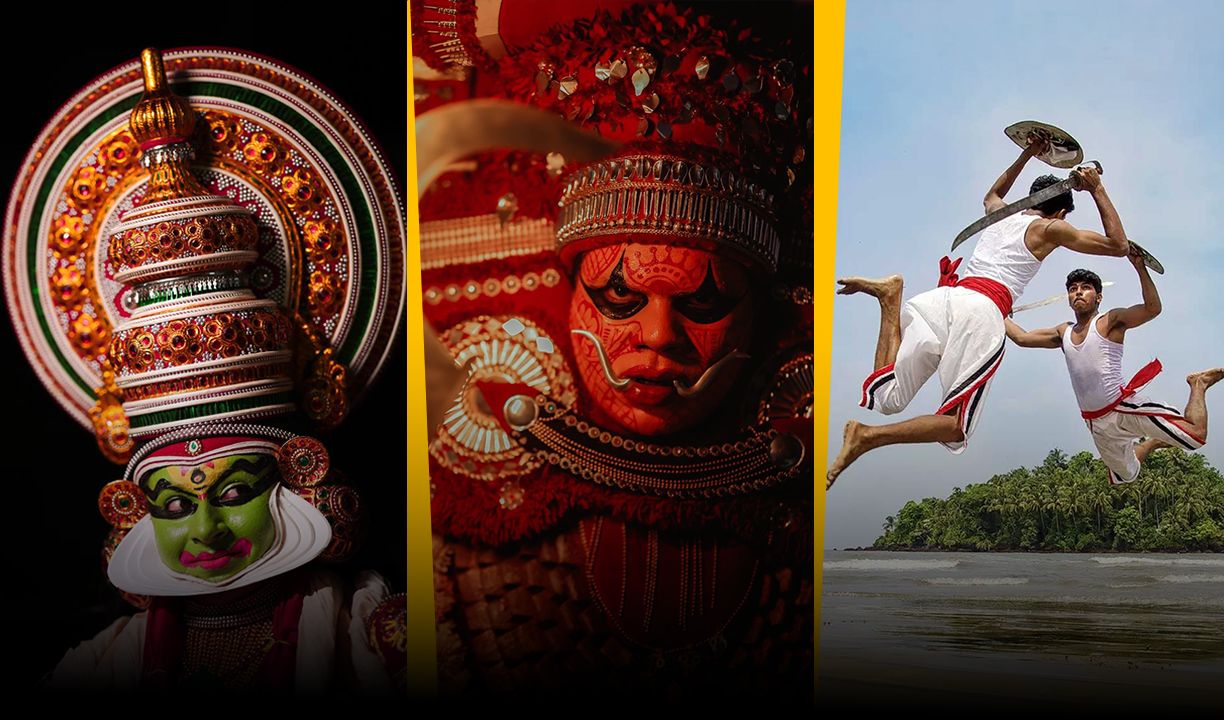
Kerala Traditional Performing Arts Guide | Kathakali, Theyyam & Kalaripayattu

Kerala's performing arts are not costumes and choreography built for tourists - they are centuries-old systems of storytelling, worship and combat that still happen the way they always have, in temple courtyards and training halls across the state. Kathakali, Theyyam and Kalaripayattu are the three you're most likely to encounter, and they are fundamentally different things: a classical dance-drama, a sacred ritual of possession, and a martial art. This guide explains what each one actually is, what to expect if you attend, and where in Kerala you can experience them - including which of these you can book directly through Indiaeve.
Key Takeaways
Kathakali, Theyyam and Kalaripayattu are three distinct traditions - dance-drama, ritual worship, and martial art - not variations of the same thing.
Fort Kochi is the easiest place to see all three in a single, tourist-accessible, English-narrated setting, with daily shows bookable through Indiaeve.
Authentic Theyyam is a seasonal, temple-run ritual concentrated in Kannur and Kasaragod (roughly October to May) - it isn't a ticketed stage show, so plan travel and timing around temple schedules rather than a fixed booking.
Kathakali's makeup system (Vesham) tells you a character's nature at a glance - green for noble, black for demonic, and so on - and knowing it changes how you watch the performance.
Always confirm show timings, dress expectations and photography rules directly with the venue or temple before you travel, since these can change by season and location.
Kathakali: Kerala's Classical Dance-Drama
Kathakali is Kerala's most iconic classical art form - a largely wordless dance-drama that brings stories from the Ramayana, Mahabharata and Puranas to life through elaborate makeup, towering costumes, precise hand gestures (mudras) and intense facial expression. The name literally means “story-play” (Katha = story, Kali = play). Traditionally, performances unfolded over an entire night in a temple courtyard; today, most visitors see a condensed, English-narrated version designed to fit a two- to three-hour evening.
How a Kathakali Performance Is Built
The performer doesn't simply dance to music - the story is carried through a layered combination of elements, all happening at once:
Facial expressions and eye movements
Hand gestures (mudras)
Body movement and posture
Vocal storytelling by two onstage singers
Percussion - chenda, maddalam, chengila and ilathalam
Elaborate costume and makeup
The performers communicate the story visually; the singers narrate it. It's this combination - not dance alone - that makes Kathakali one of Kerala's most detailed performing arts.
History of Kathakali
Kathakali dates to around the 17th century, evolving from earlier dance-drama traditions such as Ramanattam, associated with the King of Kottarakkara, and Krishnanattam, patronised by the Zamorins of Calicut. Over the following centuries it was refined by royal households, Namboothiri families and local artists - with Kalakathu Kunchu Nair, Pattikamthodi Ravunni Menon and others credited with codifying its training. Institutions such as Kerala Kalamandalam later formalised its teaching, moving performances gradually from purely devotional temple settings into theatres and cultural centres, where most visitors encounter it today.
What to Expect at a Kathakali Performance
Kelikottu: a pre-performance percussion announcement that builds anticipation before the show starts.
Makeup application (Theppu): artists apply vivid face paint and the signature white Chutti border along the jawline - many tourist venues let you watch this process before the show.
Wordless storytelling: mudras, facial expressions, and body language narrate the tale, with no spoken dialogue.
Live music: two singers and a percussion team drive the emotional pace of the story.
Costume: large pleated skirts (Uduthukettu), crowns and ornaments, collectively called Koppu.
Most tourist-oriented shows run 1–2 hours; full traditional performances can run 6 hours or more, occasionally through the night.
Understanding Kathakali Characters: The Vesham System
Kathakali's makeup style, or Vesham, tells the audience a character's nature before they say or do anything.
Pacha Vesham (green): Noble, heroic, and divine characters - Krishna, Rama, virtuous kings. Green symbolises purity, with coral-red lips and detailed eye makeup.
Kathi Vesham (knife): Powerful but flawed anti-heroes, such as Ravana. A green base with a red, knife-shaped mark on the cheek signals cunning beneath strength.
Thadi Vesham (beard), three types: Chuvanna Thadi (red beard) for aggressive, evil characters like Dushasana; Vella Thadi (white beard) for divine or wise beings such as Hanuman; Karutha Thadi (black beard) for forest-dwelling, villainous characters.
Kari Vesham (black): Demons, hunters and forest dwellers - a jet-black face with red and white dotted patterns for a fierce, intimidating look.
Minukku Vesham (radiant): Gentle, spiritual characters - sages, messengers, female roles - in a natural yellowish-orange tone.
Beyond these five categories are special one-off characters, such as Jatayu (the eagle), Hamsam (the swan) and Karkotaka (the serpent), each with its own distinct makeup.
Theyyam: Kerala's Living Ritual Art
Picture a village shrine in North Kerala before sunrise. Drums build slowly in the dark. A performer appears in bright colour, elaborate face paint and a towering headpiece - and for the people gathered around, this is not a show. It is worship. Theyyam is a ritual art tradition, practised mainly in the Malabar region, in which the performer is believed to embody a deity or ancestral spirit during the performance. It sits closer to religious ritual than to staged entertainment, and that distinction shapes everything about how it should be experienced.
Where to Experience Theyyam
Kannur - the heart of Theyyam: Most Theyyam performances happen in temples, village shrines (kavus), and sacred spaces across Kannur district. Notable sites include Madayi Kavu, known for Mari Theyyam and other rarer forms, and Parassinikadavu Temple, which holds Theyyam performances year-round rather than only in the traditional season - making it the most accessible option for visitors on a fixed schedule.
Kasaragod: Also rich in Theyyam tradition, with performances at temples, kavus, and ancestral family homes. Customs and schedules vary by location, so this is best approached with a local guide or homestay host rather than a fixed itinerary.
When Is Theyyam Performed?
The main Theyyam season runs roughly from October to May, though exact dates depend on the individual temple, local custom and the Malayalam calendar. Parassinikadavu is the notable exception, with daily Theyyam performances year-round, typically between 5:30 AM and 8:30 AM. For any other temple, treat dates as provisional until confirmed directly, ideally through a local contact rather than a general listing.
Visitor Etiquette for Theyyam
Follow local customs and temple rules - this is an active religious ritual, not a performance for an audience.
Arrive early; many Theyyams happen at night or before sunrise.
Ask permission before photographing performers or rituals.
Avoid disturbing performers, priests or the ritual itself.
Confirm date, time and location directly before travelling, especially outside Parassinikadavu.
Kalaripayattu: India's Ancient Martial Art
Alongside Kerala's dance and ritual traditions is a martial system built around speed, flexibility, discipline and weapon skill: Kalaripayattu. It's widely considered one of India's oldest structured martial traditions, and it combines unarmed combat, weapon training and body-conditioning within a single system - practised today for self-defence, fitness, cultural preservation and stage demonstration alike.
What the Name Means
The word combines two Malayalam terms: kalari, a training ground or arena, and payattu, meaning practice or combat exercise. Together, the name describes disciplined training in martial skill. A traditional kalari is not simply a gym - it's a space where students are taught body control, movement and respect for the teacher (Gurukkal) and the training lineage itself.
Origins
Kalaripayattu's exact origin isn't settled history - it survives through legend, oral tradition and scattered historical reference rather than a single documented starting point. One popular legend credits its introduction to the sage Parasurama, though this is tradition rather than verified history. What's clear is that it developed alongside Kerala's regional and warrior history over a long period, and training continues today both in traditional kalaris and in fitness, theatre and cultural-performance settings.
Why It's Called “The Mother of All Martial Arts”
Kalaripayattu is often described this way because of its age and the breadth of its training system - body conditioning, armed and unarmed combat, and movement work within one tradition. The claim that other Asian martial arts descend directly from it is part of popular belief and folklore; historians don't treat it as an established, agreed fact. It's worth mentioning to visitors as a well-known claim, not as settled history.
What to Expect at a Kalaripayattu Demonstration
Warm-up sequences: dramatic stretches and jumps that double as a display of flexibility and control.
Empty-hand combat forms: choreographed strikes, blocks, and holds performed by pairs of trained practitioners.
Weapon work: staged combat with traditional weapons such as the kettukari (long stick), sword and shield, and the urumi (flexible sword) - the visual highlight for most first-time viewers.
Narration: most tourist-facing venues explain each phase in English as it happens, which makes this the most immediately accessible of the three art forms for visitors with no background context.
Tourist demonstrations typically run 45 minutes to an hour - shorter and more physically dynamic than a Kathakali or Theyyam performance, which is part of why it tends to work well for families and children.
Kathakali vs Theyyam vs Kalaripayattu: What's the Difference?
The three are often mentioned in the same breath, but they serve completely different purposes - one tells a story, one is worship, one is combat training.
Feature | Kathakali | Theyyam | Kalaripayattu |
Type | Classical dance-drama (storytelling) | Ritual possession dance (sacred worship) | Martial art (combat demonstrations) |
Best For | First-timers, mythology lovers, photographers | Deep cultural immersion, ritual enthusiasts | Families, action seekers, fitness enthusiasts |
Where | Fort Kochi (daily tourist shows) | Kannur & Kasaragod (North Kerala); daily only at Parassinikadavu | Fort Kochi (Daily tourist demonstrations) |
Typical Duration | 1–2 hrs (tourist); 6+ hrs (traditional) | 2–8 hrs (varies); daily 5:30–8:30 AM at Parassinikadavu | 45 min–1 hr |
Season | Year-round | Oct–May (peak Dec–Feb); Parassinikadavu is daily year-round | Year-round |
Booking via Indiaeve | Yes - Fort Kochi daily shows | Not directly bookable - confirm temple schedules locally | Yes - Fort Kochi daily shows |
Where to Experience These Art Forms: Venue & Booking Details
Kerala Folklore Odeum, Fort Kochi
Location: Napier Street, Fort Kochi, Kochi
Shows: Daily performances of Kathakali, Kalaripayattu, and cultural Theyyam-style demonstrations
Ticket Price: ₹1,200 (bookable via Indiaeve - confirm current pricing before booking)
Highlights: Air-conditioned viewing hall, English narration, fixed daily schedule - the most reliable single stop to see multiple art forms in one visit
How to get there:
By air: Cochin International Airport (COK), about 40 km away - take a pre-paid taxi or airport cab to Fort Kochi.
By rail: Ernakulam Junction or Ernakulam Town, roughly 10–12 km away, with local cabs, autorickshaws and buses onward to Fort Kochi.
By road: On Napier Street itself - an easy walk if you're staying near Fort Kochi beach, or a short autorickshaw ride otherwise.
Theyyam in North Kerala
Authentic Theyyam is not a venue you book a seat at - it's a temple ritual on its own calendar. Parassinikadavu Muthappan Temple is the one reliable year-round option, with daily performances between 5:30 AM and 8:30 AM. For performances elsewhere in Kannur or Kasaragod, check Indiaeve's cultural events listings for confirmed showcase dates, or verify timings directly with the temple before planning travel.
Planning Your Visit
Book Fort Kochi shows (Kathakali, Kalaripayattu) through Indiaeve in advance during peak tourist season (Nov–Feb).
For Theyyam, build your trip around Parassinikadavu's daily schedule unless you have a confirmed date for another temple.
Dress modestly - full-length pants or skirts, no shorts - and remove shoes inside temple shrines.
Ask before photographing Theyyam performers; rules are stricter here than at tourist-oriented Kathakali or Kalaripayattu shows.
Arrive at least 20–30 minutes early for any ticketed show to allow for check-in and seating.
Kathakali, Theyyam and Kalaripayattu aren't three versions of the same cultural show - they're a dance-drama, a sacred ritual and a martial art, each with its own history, purpose and etiquette. Fort Kochi is where you go to see this range conveniently, in a single evening, with English narration. Kannur and Kasaragod are where you go to witness Theyyam as the communities who practise it actually experience it - on its own calendar, not yours. Either way, the details are worth getting right before you travel: check current showtimes, book Fort Kochi tickets through Indiaeve, and confirm Theyyam schedules directly if you're heading north.
Quick Answers to Common Questions
What is the difference between Kathakali and Theyyam?
Kathakali is a classical dance-drama performed on stage with elaborate makeup and costumes, telling stories from epics like the Ramayana. Theyyam is a ritual in which the performer is believed to embody a deity, performed mainly in North Kerala village shrines as an act of worship rather than staged entertainment.
Which Kerala art form is best for families with children?
Kalaripayattu demonstrations are fast-paced, short and easy for kids to follow. Fort Kochi's combo shows (Kathakali + Kalaripayattu) also work well for families wanting to see more than one art form in a single visit.
Can I watch Theyyam outside of peak season?
Yes - Parassinikadavu Muthappan Temple in Kannur holds Theyyam performances daily, year-round, typically between 5:30 AM and 8:30 AM. Most other temples follow the traditional October–May season and should be confirmed individually.
Do I need to book Kathakali or Kalaripayattu tickets in advance?
For Fort Kochi's Kerala Folklore Odeum, tickets can be booked in advance through Indiaeve, which is recommended during peak tourist season (November–February).
Can I book Theyyam through Indiaeve?
Not directly - Theyyam is a temple-run ritual rather than a ticketed show. Check Indiaeve's cultural events listings for any confirmed showcase dates, or verify timings with the temple directly.
What should I wear to a traditional performance in Kerala?
Modest clothing - full-length pants or skirts, no shorts. Remove your shoes inside temple shrines, and dress especially conservatively for Theyyam out of respect for the ritual.
How long does a Kathakali performance last?
Tourist-oriented shows typically run 1–2 hours. Traditional temple performances can run 6 hours or more, occasionally through the night.


