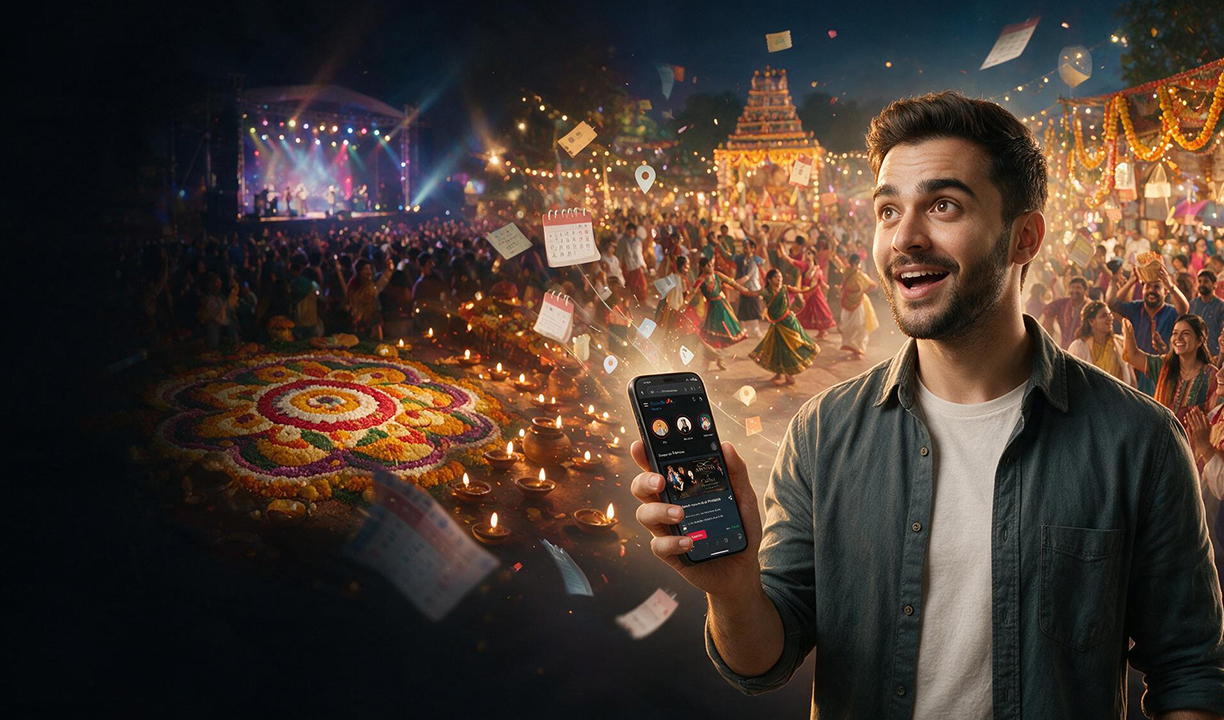
Upcoming Festivals in India: A Complete Guide to What's Coming Next

India's festival calendar rarely goes quiet for long, and the second half of 2026 is packed with major celebrations. From Onam's flower carpets in Kerala on August 26 to Diwali's five days of lights beginning November 6, the coming months bring some of the country's biggest cultural events, each shaped by centuries of tradition and each drawing crowds who plan their travel, their wardrobes, and sometimes their entire year around these dates.
Understanding when these festivals fall, and why the dates shift each year, makes it much easier to plan a visit, book tickets in advance, or simply know what to expect if you happen to be in a particular city during peak season.
Why Festival Dates Change Every Year
Most of India's major festivals follow the Hindu lunar calendar rather than the fixed Gregorian calendar most of the world uses. A lunar year runs about eleven days shorter than a solar year, so festivals like Diwali, Navratri, and Janmashtami drift earlier each year until a periodic adjustment, called an intercalary or leap month, resets the pattern. This is why Diwali fell on October 20 in 2025 but moves to November 8 in 2026, an eighteen-day forward shift that is well within the normal range of lunar drift.
A few festivals do stay fixed. Christmas on December 25 and Gandhi Jayanti on October 2 follow the solar calendar and never move. Islamic festivals like Eid work differently again, since they follow a purely lunar calendar without any leap-month correction, which is why Eid dates shift by roughly ten days every year, regardless of season.
Knowing this distinction matters if you are trying to plan. Fixed-date festivals are easy to mark on a calendar years in advance. Lunar festivals need checking each year, ideally through a panchang or an updated festival calendar, since even a one-day miscalculation can mean missing the main event.
Late Monsoon and Early Autumn: August and September
The festival season really picks up pace once the monsoon starts to ease. Onam, Kerala's most important harvest festival, falls on August 26 in 2026 and stretches across ten days of celebration. It commemorates the mythical King Mahabali and features elaborate pookalam flower carpets laid outside homes, grand feasts served on banana leaves, and the famous snake boat races that draw spectators from across the country. If you are planning to attend, Kerala's backwaters see a sharp spike in visitors during this window, so accommodation in Alappuzha and Kochi fills up quickly.
Just two days later, on August 28, Raksha Bandhan celebrates the bond between siblings, with sisters tying a rakhi thread around their brothers' wrists in exchange for a promise of protection. It is a smaller, more domestic festival than Onam, celebrated mainly in North and West India, but it carries significant emotional weight and drives a noticeable spike in gift and sweet sales in the weeks leading up to it.
September opens with Janmashtami on September 4, marking the birth of Lord Krishna. Communities across Mathura and Vrindavan, considered Krishna's birthplace and childhood home, host elaborate midnight celebrations, while Mumbai and other Maharashtra cities are known for dahi handi, a tradition where human pyramids attempt to break a pot of curd hung high above the street.
Ganesh Chaturthi follows on September 14, arguably one of the most visually spectacular festivals in the country. Clay idols of Lord Ganesha are installed in homes and elaborately decorated public pandals, worshipped for up to eleven days, and then immersed in rivers, lakes, or the sea in a ceremony called visarjan. Maharashtra, and Mumbai in particular, hosts some of the largest public celebrations, with certain pandals attracting hundreds of thousands of visitors over the festival's duration.
The Peak Festive Stretch: October and November
October through November is widely considered the single best window for experiencing Indian festivals, both for the sheer concentration of major events and for the pleasant post-monsoon weather across most of the country.
Navratri begins on October 11 and runs for nine nights, honoring the goddess Durga through fasting, prayer, and dance. Gujarat's Garba and Dandiya Raas celebrations, where dancers move in concentric circles to rhythmic drumming, are considered among the most immersive festival experiences in India, and cities like Vadodara set up massive public grounds specifically for the nine nights of dancing.
Durga Puja reaches its peak around October 19, with elaborate pandals across West Bengal, particularly in Kolkata, showcasing artistic idols of the goddess Durga defeating the demon Mahishasura. The following day, October 20, brings Dussehra, which marks the same underlying theme of good triumphing over evil but through a different narrative, the victory of Lord Rama over the demon king Ravana, often marked by burning towering effigies in public grounds.
Karwa Chauth on October 29 is a more intimate observance, where married women in North India fast from sunrise to moonrise for their husbands' well-being, breaking the fast only after sighting the moon.
Then comes Diwali, the festival most people associate with India, even if they know little else about its calendar. In 2026, the main day, Lakshmi Puja, falls on Sunday, November 8, with the full five-day festival running from Dhanteras on November 6 through Bhai Dooj on November 10. Dhanteras is traditionally considered an auspicious day for buying gold or new utensils. Choti Diwali on November 7 involves smaller-scale lighting and cleaning rituals, and the main night on November 8 is when homes are lit with diyas, fireworks fill the sky, and Lakshmi, the goddess of prosperity, is welcomed inside. Govardhan Puja on November 9 and Bhai Dooj on November 10 close out the five days, the latter celebrating the bond between brothers and sisters in a mirror of Raksha Bandhan earlier in the year.
For travelers, Ayodhya and Varanasi are considered two of the most atmospheric places to experience Diwali, the former for its massive display of earthen lamps along the Saryu river, and the latter for Dev Deepawali, celebrated roughly two weeks after the main festival, when the ghats along the Ganges are lit with an extraordinary number of lamps.
Chhath Puja follows on November 15, a demanding festival dedicated to the Sun God, observed primarily in Bihar, Uttar Pradesh, and Jharkhand, involving fasting and rituals performed standing in river water at sunrise and sunset.
Late-Year Celebrations
As the year winds down, the Hornbill Festival in Nagaland typically runs in the first ten days of December, showcasing the cultural diversity of Northeast India through tribal dance, music, indigenous games, and craft. It has grown into one of the most distinctive festival experiences in the country precisely because it represents a part of India that mainstream festival coverage often overlooks.
Christmas on December 25 rounds out the year, celebrated with particular vibrancy in Goa, Kerala, and across the Northeast, where Christian communities have deep historical roots. Goa in particular sees church services, festive markets, and beach parties that blend religious observance with celebration late into the night.
Planning Around Festival Season
A few practical points make festival travel far smoother. Train tickets for major routes during Diwali and Durga Puja tend to sell out weeks in advance, and Indian Railways opens bookings 120 days ahead, so early booking is worth the effort if you know your travel dates. Flight prices for festival periods typically rise sharply within thirty days of the event, so booking during the sixty to ninety-day window before a major festival tends to offer the best balance of price and availability. Hotels in high-demand cities like Varanasi, Jaipur, and Kolkata during their respective peak festivals should ideally be booked two to three months ahead.
It also helps to think about festivals in clusters rather than isolated dates. The run from Navratri through Bhai Dooj, roughly October 11 through November 10 in 2026, effectively forms one continuous festive season across much of North and East India, meaning cities in this belt will be busier, more expensive, and more atmospheric for the better part of a month.
Regional Variation Is the Real Story
One thing that surprises first-time visitors is how differently the same festival can look depending on which state you're in. Deepavali in Tamil Nadu is actually observed a day before Diwali in the north, timed to Naraka Chaturdashi rather than Lakshmi Puja, and the rituals around it lean more toward oil baths and family gatherings than the fireworks-heavy celebration common in Delhi or Jaipur. Ganesh Chaturthi is a fairly modest home observance in much of North India but becomes a ten-day civic event in Maharashtra, with some Mumbai pandals rivaling small festivals in scale on their own. Durga Puja, similarly, is a five-day citywide arts event in Kolkata, built around elaborately themed pandals that double as temporary art installations, while in other parts of the country, it folds quietly into the broader Navratri and Dussehra observance without the same pandal culture.
This regional layering is worth keeping in mind when reading any generic festival calendar, since a single date can represent several distinct experiences depending on location. Anyone planning travel specifically to witness a festival should look past the date itself and research how that particular festival is marked in the specific city or state they intend to visit, since the difference between, say, Durga Puja in Kolkata and Durga Puja in Delhi is substantial enough to change the entire trip.
Quick Reference: Major Festivals Ahead in 2026
Festival | Date (2026) | Region of Prominence |
Onam | August 26 | Kerala |
Raksha Bandhan | August 28 | North and West India |
Janmashtami | September 4 | Mathura, Vrindavan, Maharashtra |
Ganesh Chaturthi | September 14 | Maharashtra, Karnataka |
Navratri begins | October 11 | Gujarat, Pan-India |
Durga Puja (Ashtami/Navami) | October 19 | West Bengal |
Dussehra | October 20 | Pan-India |
Karwa Chauth | October 29 | North India |
Dhanteras | November 6 | Pan-India |
Diwali (Lakshmi Puja) | November 8 | Pan-India |
Bhai Dooj | November 10 | Pan-India |
Chhath Puja | November 15 | Bihar, UP, Jharkhand |
Hornbill Festival | Early December | Nagaland |
Christmas | December 25 | Goa, Kerala, Northeast India |
Frequently Asked Questions
Why does Diwali fall on a different date every year?
Diwali follows the Hindu lunar calendar and is fixed to Amavasya, the new moon night, in the month of Kartik. Because the lunar year is shorter than the solar year, the Gregorian date shifts by roughly eleven days annually, occasionally jumping further when a leap month is added to the calendar.
Which Indian festival draws the largest crowds?
Diwali and Durga Puja are generally considered the highest-turnout festivals nationally, though Ganesh Chaturthi in Mumbai and Navratri in Gujarat rival them in terms of sheer public participation within their regions.
Is October to November really the best time to experience Indian festivals?
For sheer concentration of major celebrations and comfortable weather, yes. This period includes Navratri, Durga Puja, Dussehra, and Diwali within a roughly four-week span, making it the busiest and most vibrant stretch of the entire festival calendar.
Do festival dates ever get officially confirmed close to the event?
For lunar festivals, yes. While panchang-based calculations give reliable dates well in advance, official government holiday notifications are sometimes only finalized a few months ahead, so it's worth double-checking dates as the event approaches, particularly for regional variations.


